

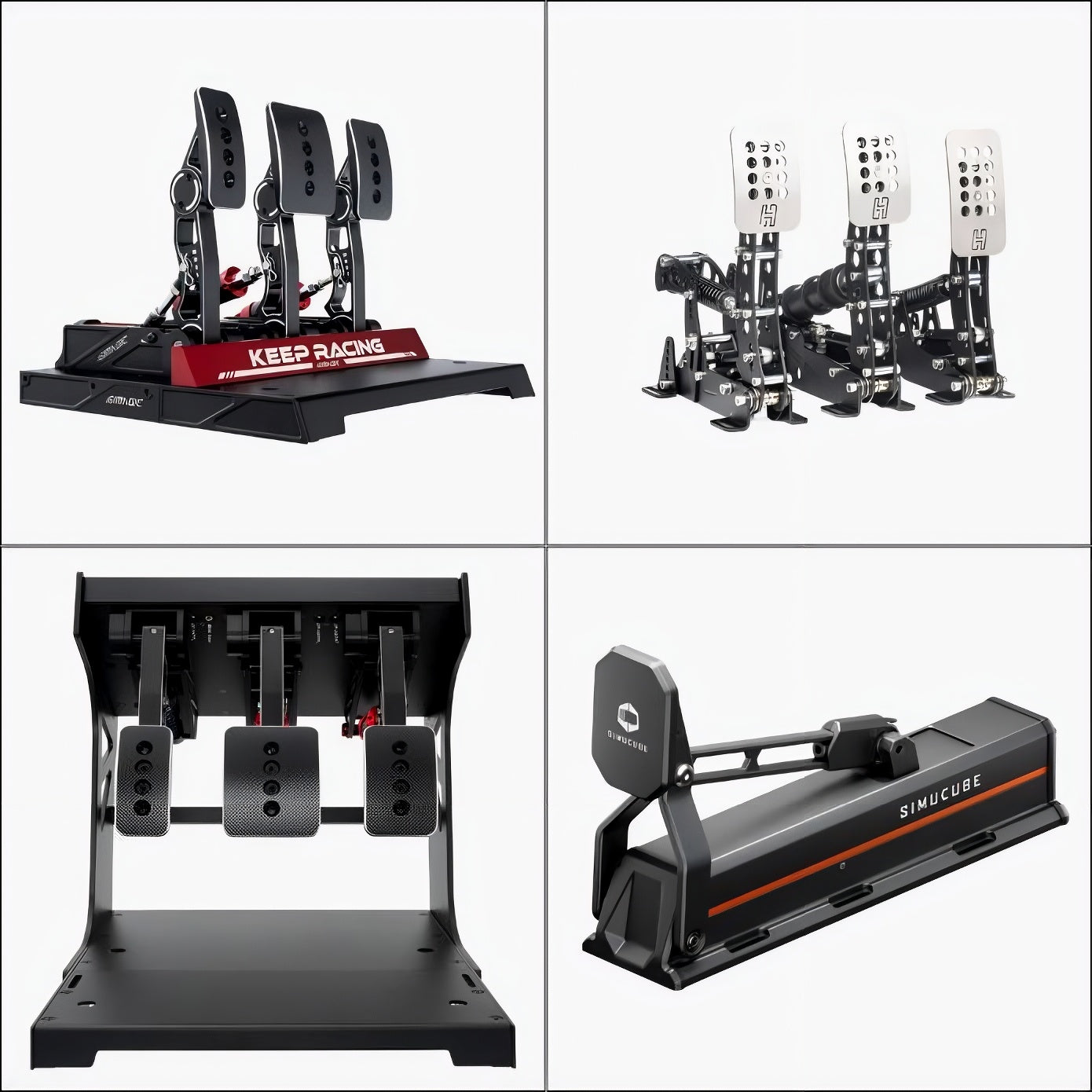
Quick Answer: The best pedal set for sim racing depends on four things: brake technology, pedal configuration, cockpit compatibility, and your experience level. For most sim racers, moving to a load cell brake pedal is the single most impactful upgrade they will make. Start there, then decide how far you want to go.
Your pedals are the most-used contact point between you and the simulator. You press the brake hundreds of times per lap. If the pedal gives you inconsistent feedback, your braking becomes inconsistent. That costs lap time and makes driving harder than it needs to be. This guide explains what to look for, which pedal type suits which driver, and how to compare options before you buy.
What Should You Look for in Sim Racing Pedals?
Before comparing products, understand what actually separates a good pedal set from a basic one.
Brake feel is the most important factor. How the pedal responds when you press it determines how consistently you can repeat a braking point. A pedal that measures force rather than travel gives you more repeatable results.
Throttle control matters for corner exit. A smooth, linear throttle pedal helps you apply power progressively without causing wheelspin or snap oversteer in powerful cars.
Pedal travel refers to how far the pedal moves when pressed. Some drivers prefer a short, stiff brake travel. Others prefer more movement. This is partly personal preference and partly dependent on the pedal technology used.
Adjustability covers pedal spacing, height, angle, and brake pressure. Being able to match the pedal position to your seating posture reduces fatigue over long sessions.
Mounting determines how the pedal set attaches to your cockpit. Most sets use a standard mounting pattern, but some require a separate baseplate. Check before ordering.
Which Type of Pedal Set Is Right for You?
Two-pedal sets include throttle and brake only. They suit Formula-style driving where a manual clutch is not used, or beginners starting out without a cockpit clutch requirement. The Simagic P500 2-Pedal Set at 189 EUR is a practical starting point.
Three-pedal sets add a clutch, which is required for manual gear changes in rally, touring car, and road car simulations. The clutch also allows more advanced start procedures in iRacing and similar titles. If you use an H-pattern shifter, a three-pedal set is necessary.
Expandable sets let you start with two pedals and add a clutch later. Simagic sells individual clutch pedals compatible with their P500, P700, P1000, and P2000 series, so you are not locked into buying a full three-pedal set immediately.
For beginners, a two-pedal load cell set is a sensible entry point. For drivers already using a shifter or planning to, go straight to a three-pedal setup.
Why Does the Brake Pedal Matter So Much?
The brake pedal is responsible for more lap time variation than any other input. Drivers who brake inconsistently carry different speeds into corners from lap to lap. This makes car behaviour unpredictable and makes it harder to push the car to its limit.
Consistent braking requires a pedal that gives you the same response for the same input every time. That is why brake technology is the primary decision when choosing a pedal set.
Load Cell vs Other Brake Systems
Quick Answer: Load cell pedals measure how hard you press, not how far the pedal travels. This makes braking more consistent because you rely on pressure rather than pedal position.
A standard potentiometer pedal measures travel distance. Press the pedal 30mm and it registers a fixed percentage of braking. The problem is that travel-based input varies with driving conditions, fatigue, and body position.
A load cell pedal measures the force you apply. Press with 40kg of force and it registers that force as the input. Your muscle memory adapts to pressure rather than position, which produces more repeatable braking.
Hydraulic pedals take this further by using real fluid resistance. The brake feels progressive and builds resistance as you push deeper, closely replicating a real race car master cylinder. The Simagic P1000 Modular 3-Pedal Set uses load cell braking. The Simagic P2000 range moves to full hydraulic from 859 EUR.
Active pedals are a separate category. The Simucube ActivePedal Pro uses a servo motor to deliver programmable resistance that changes based on car, track, and corner. It is professional-level hardware designed for drivers who need exactly what a real car delivers on every braking zone.
Load cell is the right technology for the majority of sim racers. Hydraulic suits drivers who want the closest feel to a real car without active feedback. Active pedals suit professional and advanced drivers who want programmable, data-driven pedal behaviour.
What Features Should You Compare Before Buying?
Use this as your checklist before deciding:
|
Feature |
What to Check |
|
Brake technology |
Load cell, hydraulic, or active servo |
|
Pedal count |
Two pedals or three pedals |
|
Adjustability |
Spacing, height, angle, and brake pressure range |
|
Mounting |
Standard cockpit mount or separate baseplate required |
|
Expansion |
Can you add a clutch pedal later |
|
Connection |
USB connection to PC, compatible with all major titles |
|
Inverted option |
Pedals that hang from above for a real-car position |
Which Pedal Set Should You Consider?
Once you understand what you need, match it to a product that fits.
For load cell braking at an accessible price, the Heusinkveld Sim Pedals Ultimate+ 3-Pedal Set is a Dutch-engineered set widely used by serious sim racers across Europe. At 1,199 EUR it is a significant investment, but it is built for long-term use and requires no upgrades.
For a modular approach where you configure the set around your needs, the Simagic P1000 range offers load cell and hydraulic versions in two-pedal and three-pedal configurations, with individual clutch pedals available separately.
For active pedal technology, the Simucube ActivePedal Pro delivers programmable resistance profiles and is the most advanced option available in this collection.
To compare products side by side, read the best sim racing pedals comparison which covers each model in detail.
Check Compatibility Before You Buy
All pedal sets in this collection connect via USB and work with all major sim racing titles and wheelbases. There are no proprietary connection requirements between pedals and wheelbases.
The main compatibility question is cockpit mounting. Some pedal sets require a separate baseplate to mount to an aluminium cockpit frame. Heusinkveld Sprint and Ultimate baseplates are available separately. Simagic pedals include mounting hardware, but check the product page for your specific model.
If you are adding pedals to an existing cockpit, confirm the mounting pattern matches your rig before ordering.
Ready to Choose Your Sim Racing Pedals?
You now know the difference between load cell, hydraulic, and active pedal systems. You know whether you need two or three pedals, what adjustability matters for your setup, and what to check for cockpit compatibility.
Browse the full range of sim racing pedals at Apex300, including sets from Simagic, Heusinkveld, Simucube, and MOZA. All prices include VAT and orders ship from a European warehouse across Finland and Central Europe.


Share:
How to Choose the Right Racing Steering Wheel for Sim Racing
How Much Should You Spend on a Sim Racing Setup? A Practical Guide for Every Budget